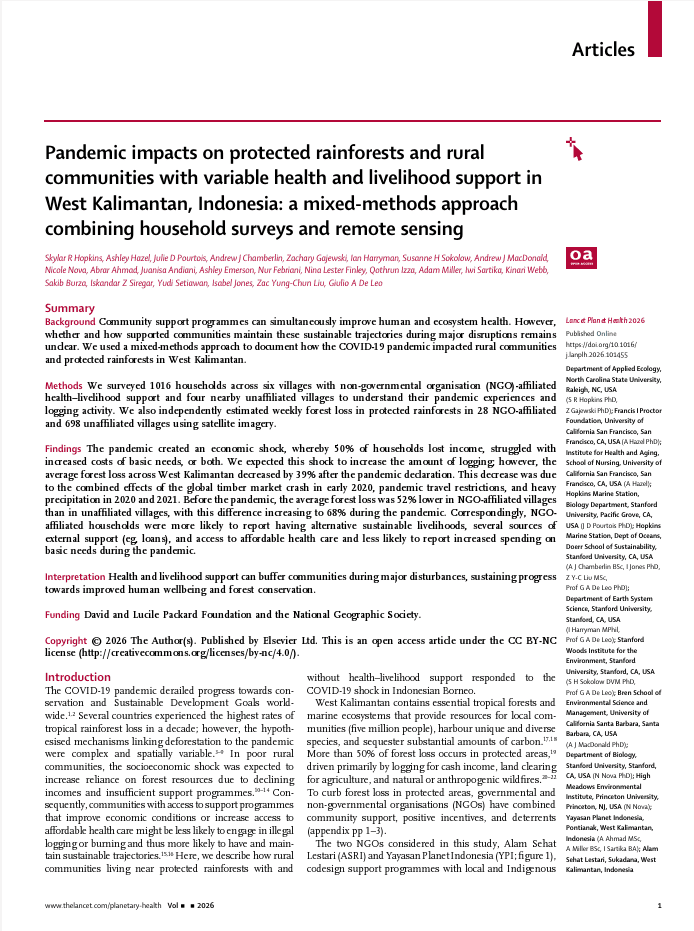
Pandemic Impacts on Protected Rainforests
and Rural Communities in West Kalimantan

A mixed-methods study combining household surveys and remote sensing to test how health-livelihood support shaped conservation and community resilience during COVID-19
Published with North Carolina State University, Stanford University, UC San Francisco, IPB University, UC Santa Barbara, and the London School of Hygiene and Tropical Medicine, alongside practitioners from Yayasan Planet Indonesia, Alam Sehat Lestari (ASRI), and Health In Harmony
in The Lancet Planetary Health, 2026
COVID-19 stalled progress on conservation and development goals worldwide. Several countries saw their highest rates of tropical forest loss in a decade, and the working theory was straightforward:
Lost income leads to greater reliance on logging and land-clearing for cash and subsistence, which leads to more forest loss in protected areas.
Small surveys in Nepal, Madagascar, and West Java had reported increased illegal logging during the pandemic, but no study had paired household-level data with independently measured forest loss in the same location, at scale.
The setting and NGO partners

West Kalimantan's protected forests support roughly five million people, host exceptional biodiversity, and store vast amounts of carbon.

More than 50% of all forest loss there occurs inside protected areas, driven by
  • logging for cash income,
  • land clearing for agriculture,
  • and fire.
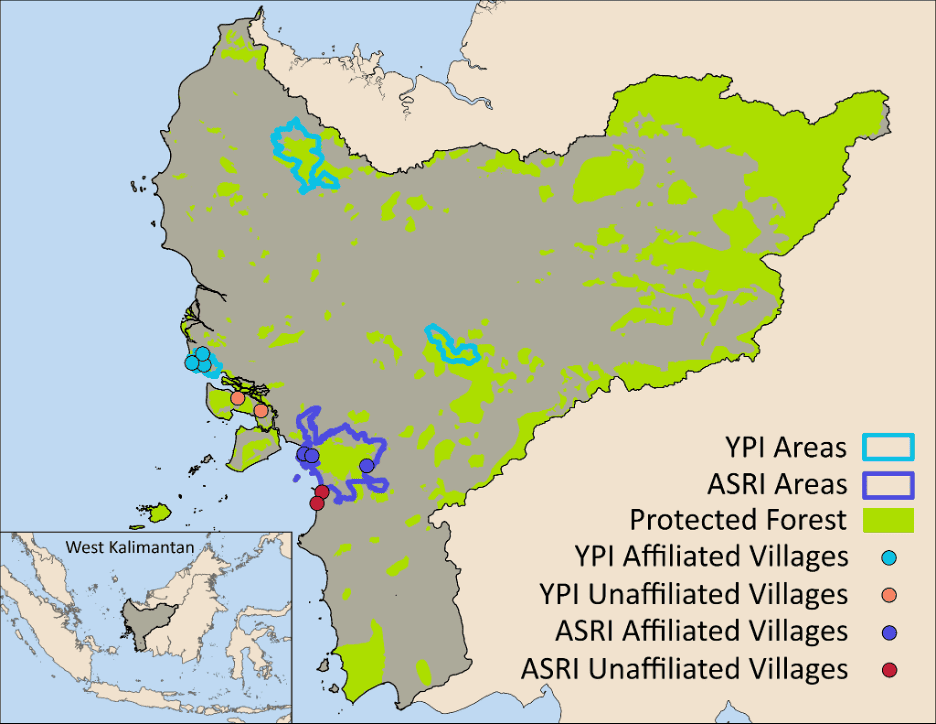
Fig 1: A map of West Kalimantan in Indonesia Borneo
The map shows the extent of protected forests, all villages that are affiliated with the two NGOs (outlined by polygons), and ten NGO-affiliated and unaffiliated villages included in the household surveys (points). 


ASRI - Alam Sehat Lestari
In partnership with communities since 2008 
Affordable health clinics, health education, sustainable livelihood training, and forest monitoring in and around Gunung Palung National Park.


YPI - Yayasan Planet Indonesia
In partnership with communities since 2017
Facilitating health support, sustainable livelihood training, Financial inclusion programs, logging-reduction incentives, and community-based forest monitoring.
Before the pandemic, NGO-affiliated villages were on sustainable trajectories.
Two competing hypotheses
The pandemic could plausibly have pushed forest loss in protected areas in either direction. The research question was which forces would win, and whether health-livelihood support changed the balance.
Forest loss could increase
Rising health care costs push households toward logging for cash income.

Lost income or support increases reliance on land-clearing for subsistence.

Travel restrictions reduce ranger patrols and other deterrents.
Forest loss could decrease
Global market crash reduces the payoff for logging in protected areas.

Government travel restrictions limit the ability to log, burn land or transport timber, especially covertly.

New economic stimulus programmes or safety nets ease pressure on the lack of cash income.
Methods
1,016
Households surveyed across 10 villages
726
villages tracked by satellite, weekly
4 years
of forest-loss data (2018-2021)
Household surveys
Six NGO-affiliated villages (3 per NGO) and four comparable, nearby unaffiliated villages were selected for household surveys, chosen for similar population size and forest proximity.
Participants recalled their experience from before the March 2020 pandemic declaration through the following 20 months.
Income & Jobs
Every income source, whether earnings rose or fell, and job type (high-, low-, or resource-impact)
Logging Behaviour
Whether households logged or burned land, and, if they stopped, why
External Support
Sources of outside financial or material support (government, NGO, family, etc.)
Health Care
Needs, use, spending, and barriers to access or affordability, before vs. during the pandemic
Biggest change
An open-ended question on the single biggest pandemic change, coded by theme
Satellite-based forest-loss model
A machine-learning pipeline turned freely available satellite imagery into a weekly, pixel-level record of deforestation across three protected-forest types, for every village in the study.

Comparing the 28 non-randomly selected NGO-affiliated villages against all other villages across the wider Kalimantan region (n=1,432) produced consistent results.
Findings
The economic shock was real 
Of all households, affiliated and unaffiliated
50%
of households lost income from at least one source during the pandemic.
53%
named economic hardship as the single biggest change of the pandemic.
Households cited rising costs of basic needs, fertiliser, fuel, food, alongside falling wholesale prices for the fish and timber that many families sell.

However, NGO affiliated households reported approximately 60% more sources of external support for money, resources, or services. 
Forest loss fell
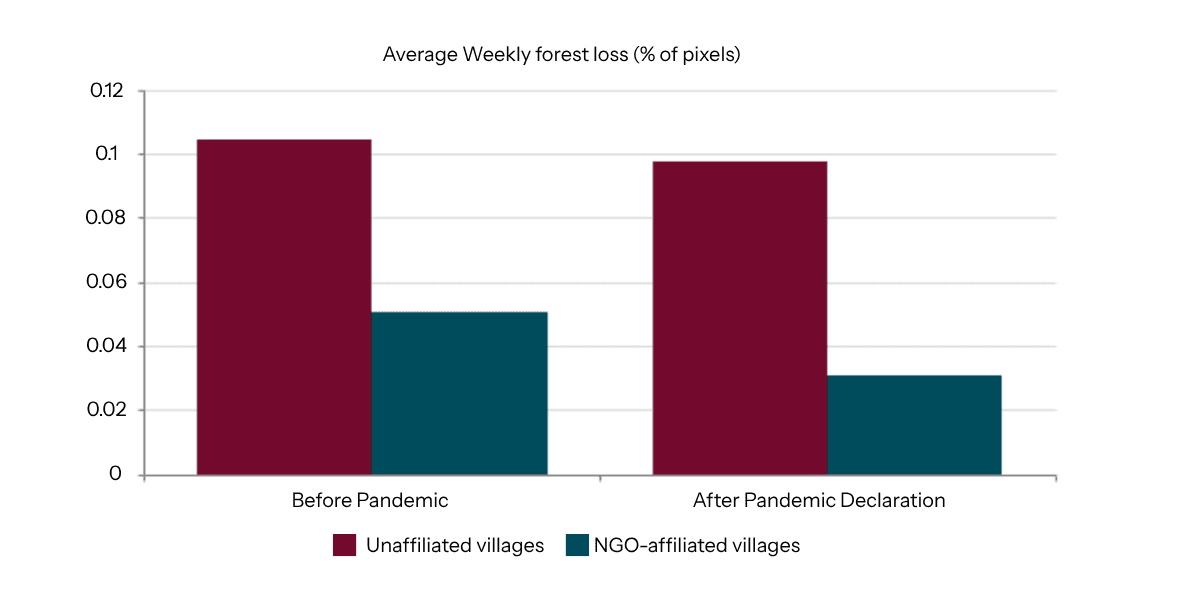
39%
Decrease in average forest loss across protected areas in West Kalimantan after the March 2020 pandemic declaration.
Communities supported by NGOs faired better and the forest loss gap widened
Forest loss was already lower in NGO-affiliated villages before the pandemic, and the gap grew larger afterward, even as both groups faced the same economic shock.
52%
lower average forest loss in ngo-affiliated villaged before the pandemic.
68%
lower average forest loss in ngo-affiliated villaged after the pandemic declaration.
What explains the NGO-affiliated advantage
Different incomes sources, less exposure
NGO-affiliated households were more likely to hold low-impact jobs and less likely to hold high-impact jobs like logging, mining, or commodity farming (ORs 0.58-2.21, all p<0.005).
More sources of support
NGO-affiliated households reported about 60% more sources of external support, loans, resources, services, than unaffiliated households (p<0.0001, both NGOs).
Insulated from cost pressure
YPI-affiliated households were half as likely to name rising basic-needs costs as their biggest pandemic change (17% vs. 29%, p=0.002).
Decoupled from the timber market
Forest loss in unaffiliated villages tracked the global timber price index; in NGO-affiliated villages it did not respond to market swings at all.
Recovery and Environmental Resistance
Household economies clearly were not resistant to the pandemic shock.  Incomes fell, costs rose, and health care became harder to afford across NGO-affiliated and unaffiliated villages alike. The economic shock did not spare anyone.
Despite that shock, logging did not increase in NGO-affiliated villages, and the pre-pandemic gap in forest loss widened. Health-livelihood support acted as a buffer for the forest, even where it could not fully buffer household finances.
What this means in practice
Support programs are a conservation strategy
Affordable health care, livelihoods, and access to external support gave households options besides logging, turning social protection into a forest-protection mechanism.
Fine-scale, mixed-methods data changes the story
Regional or country-level analyses elsewhere reported forest loss increasing during the pandemic; only pairing household surveys with local satellite data revealed why West Kalimantan diverged.
Reducing poverty remains central to planetary health
The findings reinforce that social protection and poverty reduction are foundational, not secondary, to durable conservation outcomes.
The added value of this study
While we found limited studies about how the COVID-19 pandemic impacted forests using remote sensing to analyze forest loss and a few small surveys of conservation and forestry professionals on illegal logging rates and reliance on forest resources, this is the first study of its kind to combine remotely sensed forest loss data and household surveys in the same location.

This fine-scaled analysis clarified how forest loss was impacted by increasing the need for cash incomes, reducing the ability to log because of lockdowns and high precipitation, and reducing cost-benefit ratios because of market crashes.
This dynamic and complex socioecological system provides an opportunity to describe resistance and resilience to a system shock.
SUMMARY

The gap widened from 52% lower pre-pandemic to 68% lower during the pandemic, suggesting support programmes increased community resilience rather than collapsing under stress.

Affordable health care, resilient livelihoods, and access to external support gave households options besides logging, turning social protection into a forest-protection mechanism.

- Communities that had already co-designed health and livelihood programs with local nongovernment organizations experienced significantly lower forest loss during the COVID-19 pandemic than neighboring villages without those partnerships.

Regional or country-level analyses elsewhere reported forest loss increasing during the pandemic; only pairing household surveys with local satellite data revealed why West Kalimantan diverged.

The findings reinforce that social protection and poverty reduction are foundational, not secondary, in achieving both conservation and Sustainable Development Goals, especially during large-scale disruptions.


Thank you to the David and Lucile Packard Foundation and the National Geographic Society for supporting this work.
Sign up to recieve news and updates.

© 2024 Planet Indonesia

Planet Indonesia is a 501(c)(3) nonprofit organization.

 By signing up you agree that we can contact you via our email newsletter and to our Terms and Conditions and Privacy Policy.

The term ‘integrated landscape initiative’ (ILI) has gained popularity as an ‘umbrella concept’ that describes projects that aim to explicitly improve food production, biodiversity conservation, and rural livelihoods on a landscape scale.

It describes approaches that consider the entire landscape, including its environmental, social, and economic aspects, by bringing together diverse stakeholders to manage land use in a way that balances competing needs, aiming for sustainable outcomes across the whole system, rather than focusing on isolated issues within the landscape.