<< Back to Learning Center
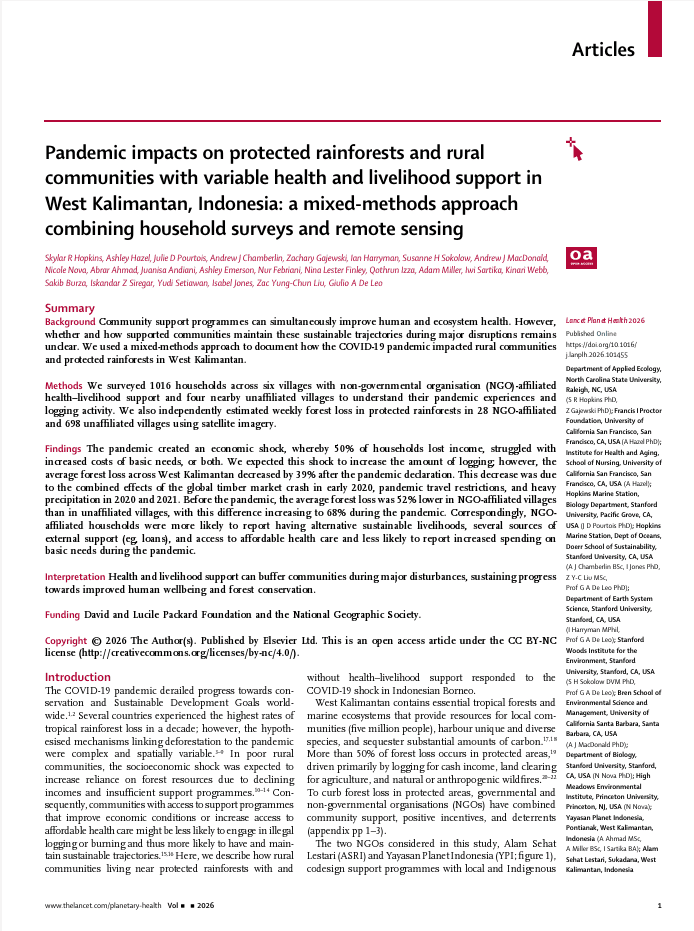
Pandemic impacts on protected rainforests and rural communities with variable health and livelihood support in West Kalimantan, Indonesia

In participation with researchers from North Carolina State University, Stanford University, UC San Francisco, IPB University, UC Santa Barbara, and the London School of Hygiene and Tropical Medicine, alongside practitioners from Yayasan Planet Indonesia, Alam Sehat Lestari (ASRI), and Health In Harmony, this study uses the COVID-19 pandemic, as a proxy for other disruptive shocks, including climate and economic, and assess its affect on rural communities and protected rainforests in West Kalimantan, Indonesia.
The study combined more than 1,000 household surveys with satellite monitoring of forest loss across 726 villages comparing villages with and without community-led programs. Communities that had already co-designed health and livelihood programs with local nongovernment organizations experienced significantly lower forest loss during the COVID-19 pandemic than neighboring villages without those partnerships.
Despite a severe economic shock — half of households lost income or faced rising costs — forest loss across the region actually dropped 39% after the pandemic declaration, a striking contrast to increases in rainforest loss recorded in Brazil and Ecuador over the same period. This decline in forest loss was driven by the global timber market crash, travel restrictions, and heavy rainfall.
NGO-affiliated villages fared better on both fronts: forest loss was 52% lower pre-pandemic and 68% lower during it, and affiliated households were more likely to have sustainable livelihoods, external support, and affordable health care. The findings show that integrated health–livelihood programmes can buffer communities during crises and sustain conservation gains.
Key points
- Communities that had already co-designed health and livelihood programs with local nongovernment organizations experienced significantly lower forest loss during the COVID-19 pandemic than neighboring villages without those partnerships.
- Economic shock was widespread but forest loss declined. 50% of households lost income or faced higher costs, yet average forest loss dropped 39% — the timber market crash, mobility restrictions, and heavy precipitation outweighed pressure to log.
- NGO-affiliated villages had consistently lower forest loss. The gap widened from 52% lower pre-pandemic to 68% lower during the pandemic, suggesting support programmes increased community resilience rather than collapsing under stress.
- Health–livelihood programmes acted as a buffer. Affiliated households were more likely to hold low-impact jobs, access affordable health care, and receive external support (e.g., loans), reducing the need to log for cash.
- Mixed methods revealed mechanisms that remote sensing alone would miss. Combining household surveys with satellite data let the authors disentangle competing drivers; market forces, mobility restrictions, precipitation, and community-level support, rather than just documenting net forest change.
- Implications for planetary health policy: The study provides evidence that reducing poverty and strengthening social protection are foundational to achieving both conservation and Sustainable Development Goals, especially during large-scale disruptions.
Suggested citation
Hopkins, S. R., Hazel, A., Pourtois, J. D., Chamberlin, A. J., Gajewski, Z., Harryman, I., Sokolow, S., MacDonald, A., Nova, N., Ahman, A., Andiani, J., Emerson, A., Febriani, N., Finley, N., Izza, Q., Miller, A., Sartika, I., Webb, K., Burza, S., Siregar, I., Setiawan, Y., Jones, I., Yung-Chun Liu, Z., & De Leo, G. A. (2026). Pandemic impacts on protected rainforests and rural communities with variable health and livelihood support in West Kalimantan, Indonesia: a mixed-methods approach combining household surveys and remote sensing. The Lancet Planetary Health.
Share