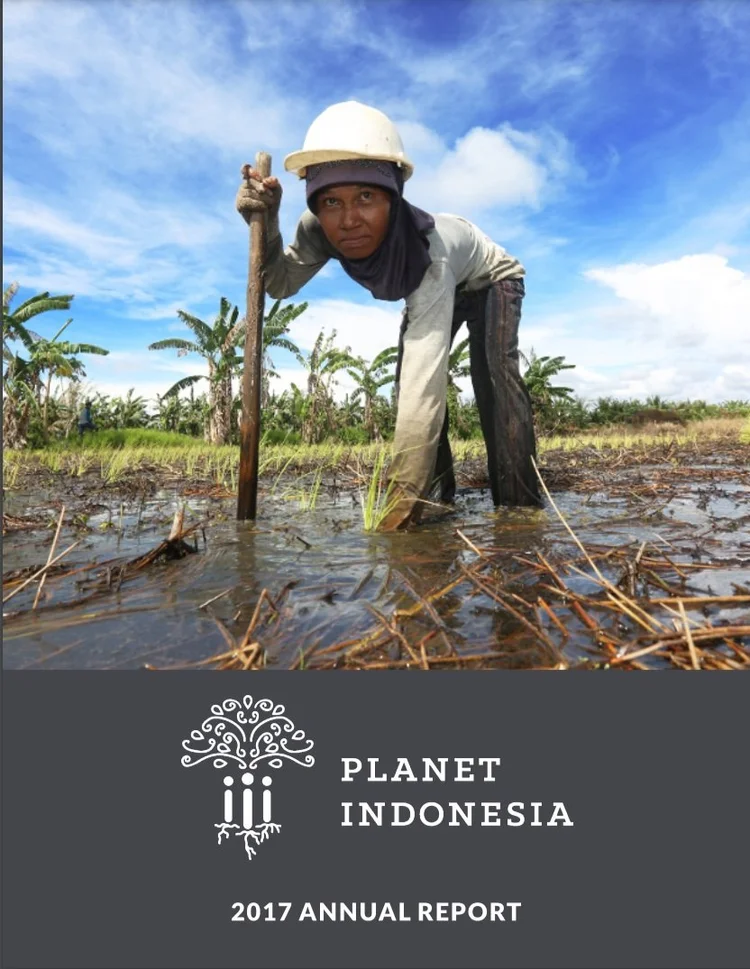
This 2017 Annual Report outlines Planet Indonesia's integrated approach to conservation, which places community well-being at the center of its environmental mission. The report emphasizes addressing the economic drivers of environmental loss—such as illegal logging and wildlife trafficking—by providing rural communities in Indonesian Borneo with the resources, skills, and "green business" opportunities needed to thrive sustainably. It highlights successful community-led initiatives across coastal mangroves and terrestrial rainforests, aiming to create a new generation of local conservation leaders.
Key points
- Protected over 30,000 hectares of the Gunung Nyiut Nature Reserve, a critical habitat for the Critically Endangered Bornean Orangutan.
- Initiated management of 1,000 hectares of communal mangrove forests in the Kubu Raya District.
- Reached over 500 households (approximately 2,500 individuals) through their programs.
- Established 5 Conservation Cooperatives, which serve as the primary vehicle for delivering community services and incentives.
- Conducted 1,200 kilometers of forest patrols to monitor and deter illegal activities.Investigated over 400 cases of illegal wildlife trade and timber crime.
Suggested citation
Planet Indonesia. (2025). 2025 Annual Report. Pontianak, West Kalimantan: Planet Indonesia.
The term ‘integrated landscape initiative’ (ILI) has gained popularity as an ‘umbrella concept’ that describes projects that aim to explicitly improve food production, biodiversity conservation, and rural livelihoods on a landscape scale.
It describes approaches that consider the entire landscape, including its environmental, social, and economic aspects, by bringing together diverse stakeholders to manage land use in a way that balances competing needs, aiming for sustainable outcomes across the whole system, rather than focusing on isolated issues within the landscape.